
Records Behind a Temecula Resident Lookup
The right first search depends on what is already known. An address points toward an APN and the Riverside ACR ownership counter. A case question points toward Riverside Superior Court. A family event points toward a vital-record application or historical index. A business or professional clue belongs in a state filing or license portal. The table keeps each Temecula resident lookup record in its proper lane.
| Record | What It Confirms | Where | Access |
|---|---|---|---|
| Assessor roll | APN, situs, assessment and ownership or tax mailing address | Riverside Property Search and ACR office | Address/APN web result; owner inspection at office under Revenue and Taxation Code section 408 |
| Recorder index | Party names, conveyances, liens and recording dates | Riverside ACR name search | Web index from 1974; Gateway Riverside for 1974 and earlier; copies paid |
| Voter status | Personal registration status, party, district and election information | California My Voter Status | Self lookup or approved-use voter file, not an open name directory |
| Court case | Party, case number, filing date, case type, docket and public disposition | Riverside Superior Court Public Access | Account and credits for name searches; clerk and courthouse routes remain available |
| Vital record or index | Birth, death, marriage or dissolution event | CDPH Vital Records and Riverside ACR | Eligibility, form, fee and authorized or informational copy rules |
| Business or professional file | Entity, agent, license status or address of record | California bizfile, DCA and Riverside FBN | Free index access; copies or filings can have separate rules |
| Unclaimed property | Reported owner name, city or ZIP clue and reporting business | State Controller search | Free name and location search; claim proof required |
| Custody index | County or state custody identity and status information | Riverside Sheriff, CDCR CIRIS or Megan's Law | Separate official systems with their own warnings and coverage |
No row proves current residence by itself. An owner may have an out-of-area mailing address. A business address may be commercial. A voter result is limited by the user's own verification or an approved file. A court hit can have the right name and the wrong person. Treat the table as a plan for corroboration rather than a promise of one definitive result.
Verify One Temecula Resident Across Records
A strong Temecula resident lookup uses two independent facts. Copy the full indexed spelling, middle initial, role, date and record number before making a conclusion. A deed legal description plus an APN is stronger than a name alone. A court party plus a case number is stronger than a broad name hit. A death index plus a probate or obituary clue can identify a former resident without turning a historical record into a current address.
- State the question. Decide whether the goal is an address clue, court case, family event, business affiliation, professional credential or historical identity.
- Anchor the name. Use an address and APN, a known date, a case type, a business name, a county or another fact that the custodian actually searches.
- Run the matching index. Search name variants and note the role, filing date, case number, document number or license number.
- Compare a second source. Check a deed against the parcel, a docket against the person and date, or a vital index against a family record.
- Order a copy only when needed. An index may locate a record, while a certified copy establishes the form and status required by the custodian.
- Docket
- The court's running record of filings, hearings, orders and other case events. It is not always the full document file.
- Index versus image
- An index is a searchable pointer with limited fields. An image is the scanned or filed record, which may cost money or require in-person access.
- Certified copy
- A copy formally issued or authenticated by the custodian. It is different from a screen result or an uncertified scan.
The address-to-owner portion belongs to the Riverside assessor and recorder workflow. The one-person task begins only after the name has a fact that can be tested.
Temecula Resident Lookup Court Modes
Temecula matters are filed in Riverside Superior Court because Temecula has no separate municipal court. The official court public-access page links to the ePublic Access portal, which requires an account. Civil Name Search and Criminal or Traffic Name Search use credits. Case-number access is free, and one paid name hit permits review of up to ten matching cases before another credit is needed.
| Index | Person or organization name in a civil or criminal/traffic category; returns a case number and filing date. |
|---|---|
| Register of Actions | Case number required; shows docket events, parties and dates allowed for remote access. |
| Calendar | Current or future seven days, with courthouse and department context. |
| Documents | Case number and document selection; nonconfidential documents are paid downloads. |
| Probate Notes | Case number; notes refresh evenings three business days before a hearing, and filings must arrive at least four court days before. |
Credits cost $1 for one, $3.50 for five, $5 for ten, $25 for 75 or $250 for unlimited use over 30 consecutive days. Downloads cost $1 per page for the first five pages, then $0.50 per page, capped at $50 per document, and remain available for 30 days. The portal limits searches and lookups to 30 in five minutes. Cookies and popups are needed, and automated queries or account evasion can lead to suspension.
Coverage is local and category-specific. Temecula small claims begins in September 1996 and Temecula civil in October 1996. Family coverage is almost all April 1992 forward, and probate is almost all July 1994 forward. Criminal legacy coverage is organized by regional courthouse, with no exact Temecula cutoff stated. A missing result is not proof that no case exists.
What a Temecula Resident Lookup Docket Shows
A court result should be read field by field. The Riverside public-access result is not the official record, and remote access is narrower than courthouse-terminal access under California Rules of Court sections 2.501-2.503. Juvenile, adoption, sealed and confidential files are not generally remote. Unlawful-detainer cases are confidential for the first 60 days, with limited interested-party access under Code of Civil Procedure section 1161.2.
- Identity: indexed person or organization, party role and any visible name variant.
- Placement: case number, filing date, courthouse and division.
- Substance: case type, register-of-actions events, hearings and a public disposition or judgment when docketed.
- Documents: selected nonconfidential filings available by paid page download; full family or criminal files may require the courthouse.
- Redactions: juvenile, adoption and sealed records are excluded, and protected identifiers are not searchable.
If a formal search is needed, the Riverside RI-MC002 records-search and copy form accepts up to two personal names with first, middle and last fields, a business name, case or citation number, case type, courthouse or document description, requester contact, payment and card authorization. A mailed request needs a self-addressed stamped envelope. An NTE check with the maker's printed name and address can handle an uncertain total.
The form lists $15 per name search, $0.50 per page, $40 certification per document, $32 off-site retrieval, $15 for a certified divorce decree, $50 for exemplification and postage. A clerk search returns case-number information rather than copies unless the copy work is requested through the stated process.
Temecula Resident Lookup Same-Name Rule
Since October 11, 2024, Riverside clerks no longer narrow public criminal or traffic name searches for a third party with date of birth or driver's-license number. The court's name and case-search policy explains the change. A defendant presenting identification may be handled differently, but a public researcher must work with the name and case-number rules. That policy makes the same-name problem more visible, not less.
Use the full indexed spelling, middle initial, case role, filing date, courthouse and category. Then compare a court result with a separate fact such as an ACR parcel, a business filing or a known family event. Do not treat a matching first and last name as identity confirmation. If the court result is important, ask the clerk about the official search and copy procedure rather than asking for protected identifiers.
Note: A paid court name hit buys access to matching cases, not certainty that every matching person is the same Temecula resident.
Temecula Resident Lookup Vital Copies
Riverside County ACR and the California Department of Public Health issue different record products. Modern birth, death, marriage and dissolution certificates are not an open resident directory. California distinguishes authorized certified copies from informational certified copies under Health and Safety Code sections 103525-103526. An informational copy may be more broadly available, can be redacted and carries a statement that it is not a valid document to establish identity.
The current CDPH forms are VS111 for birth, VS112 for death, VS113A for marriage and VS113B for dissolution. The 2026 state fee schedule lists $31 for birth, $26 for death, $19 for marriage and $18 for a dissolution certificate. Payment is by check or money order payable to CDPH Vital Records, drawn on a U.S. bank; no cash. A no-record search produces a Certificate of No Public Record and the search fee is retained.
Authorized-copy requests require a qualifying relationship or authority, a sworn statement under penalty of perjury and notarization when mailed. The CDPH diacritical-marks notice explains the 2026 rule allowing marks on birth, fetal-death, death and marriage certificates, with amendment by sworn affidavit. Confidential marriage access is limited to a party or court order under Family Code section 509. Adoption records are sealed. A divorce certificate is a summary from CDPH, while Riverside Superior Court holds the actual decree and case file. Historical indexes and archival collections can provide clues, but there is no blanket rule that modern certificates open after a simple number of years.
For a Temecula death or birth question, state the event date and place, then choose county, state, historical index or court custody before paying for a copy. The custodian's form is part of the proof.
Temecula Resident Lookup and Voter Status
California My Voter Status is a personal self-lookup. A user supplies identity and residence details to see registration status, party preference, polling place, vote-by-mail status and election information. It is not a route to browse a Temecula neighborhood or identify every person at an address.
The statewide voter file is available only for approved election, governmental, scholarly, journalistic or political purposes under Elections Code sections 2188 and 2194 and California Code of Regulations, title 2, sections 19001-19013. A statewide file costs $100. A specific-voter request costs $30 per record up to $100 and is limited to ten named voters per application. The application identifies purpose, intended use, beneficiaries, agents, vendors and security controls. Protected voters are suppressed.
Possible fields include name, county, registration identifiers, residence and mailing address, phone, email, birth details, party preference, status, registration date, precinct, districts and participation history. Participation indicates whether and how a ballot was cast, never the choice. Safe at Home participants use a confidential registration card and call 877-322-5227. That protection is one reason a missing voter result cannot be treated as evidence that a resident moved.
Temecula Resident Lookup for Heirs and Classmates
Different identity questions need different official trails. For an heir, start with a probate case or index, a death certificate or historical index, recorded affidavits or deeds and public notices. For a birth parent, use California's official adoption and court channels because adoption records are sealed. For a former classmate, ask the Temecula library, yearbook collection, Temecula Valley Genealogical Society or museum; exact local yearbook runs were not verified.
For a business owner or operator, search California Secretary of State bizfile Online and Riverside fictitious-business-name records separately. Bizfile can return an entity number, type, status, jurisdiction, addresses, agent and public filing history. DCA's license search can search Board or Bureau, license type, license number, business name, first name, last name, city, county and ZIP, with status and public address-of-record details. Neither business affiliation nor a professional address proves a home address.
Unclaimed property is another clue, not a residence result. The State Controller search accepts owner last or business name, first name and city or ZIP. A hit can show a reported owner, address fragment, reporting business and property type. Claimants must establish identity. The official unclaimed-property search makes that distinction visible.
The unclaimed-property screen belongs in a clue workflow, after the name has a date or place anchor.
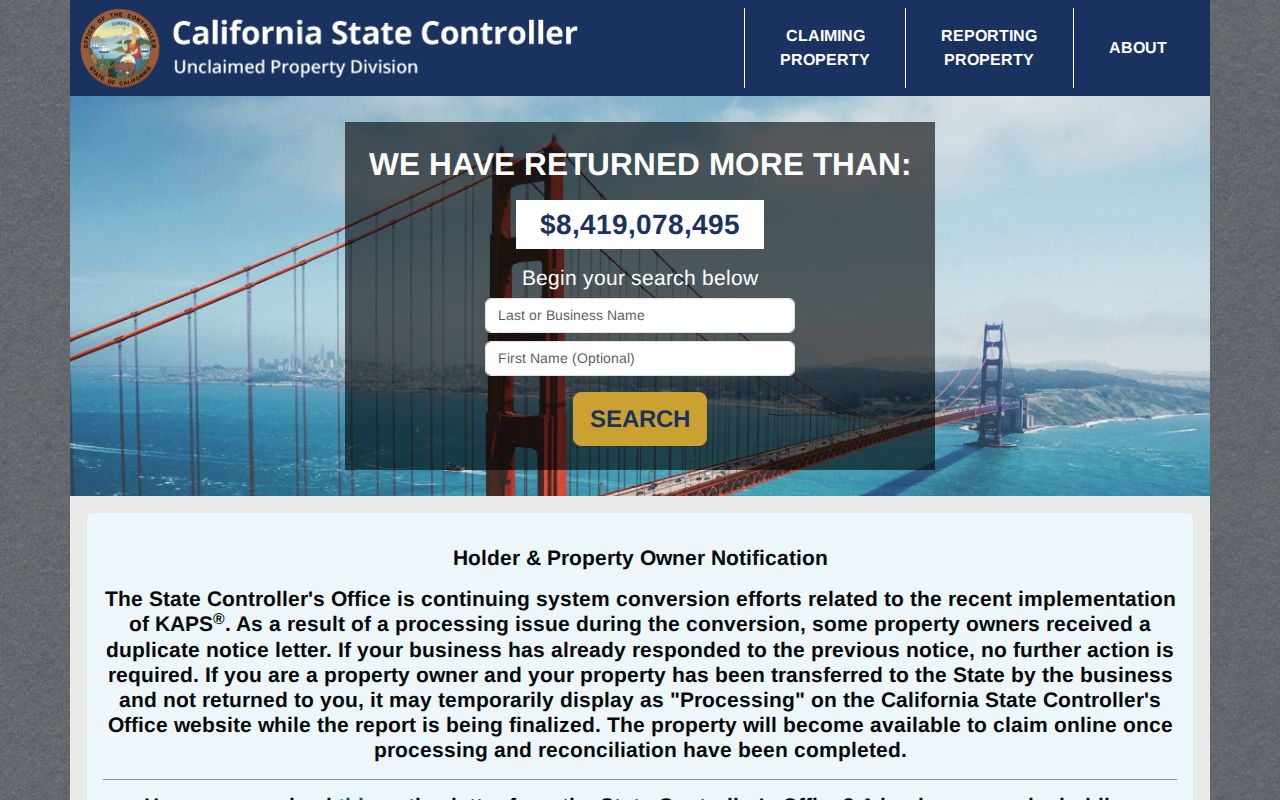
A reported account can connect a name to an older city or ZIP, but it does not establish current residence or guarantee that two same-name records are one person.
Custody indexes are separate too. The Riverside Sheriff inmate locator covers county custody, while CDCR CIRIS searches state incarcerated records by name or CDCR number. California Megan's Law has its own name, map and address modes with false-match warnings. Verify with the official system and do not turn a custody hit into a broader identity claim.
Federal Cases in a Temecula Resident Lookup
Riverside County federal civil, criminal and bankruptcy matters are in the Central District of California, not the Riverside Superior Court portal. PACER requires an account and searches federal records. The Ninth Circuit PACER fee guidance explains the federal access rules. Ordinary access is $0.10 per page with a document cap under PACER policy, and quarterly fees are waived when the account total is $30 or less. Federal records do not replace a county case search.
Use the party name, court and case context carefully. A federal result may concern a business, an older address or a different person with the same name. Compare the case caption and date with an independent record before treating it as a Temecula resident clue.
The PACER federal portal is a separate search lane from Riverside's local docket system.
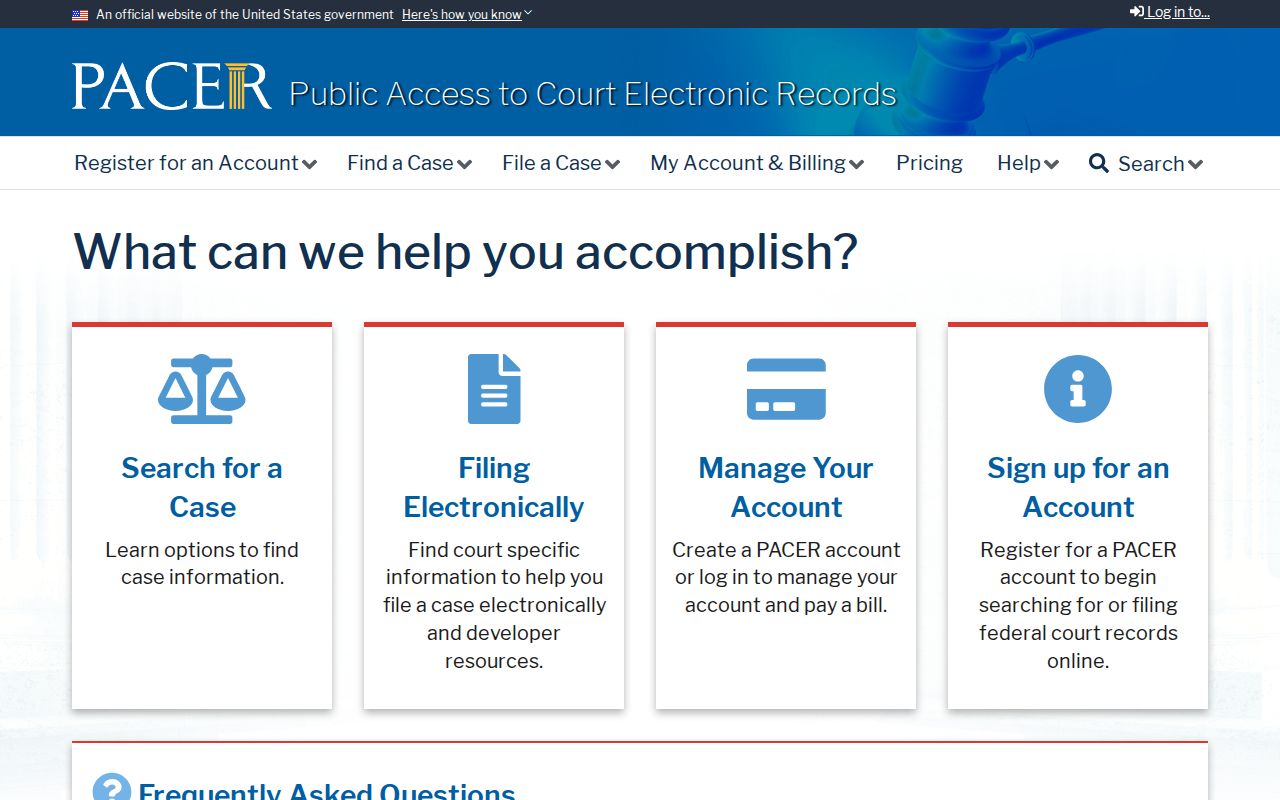
The PACER image marks the federal boundary: an account-based federal search and a county public-access search should be reported as different record systems.
Limits on a Temecula Resident Lookup
When an official index does not answer the question, the California Public Records Act is a focused fallback. Government Code sections 7920.000 and following allow a request for an identifiable existing state or local record. The agency ordinarily determines within ten days whether responsive records are disclosable, with a possible extension of up to fourteen days for unusual circumstances. Ask for segregable portions and identify the department, date range, address or APN, record type and format. The agency does not have to create a custom resident list, and privacy, law-enforcement, privilege and other confidentiality exemptions still apply.
California's Safe at Home program uses a substitute address and mail forwarding for qualifying victims and threatened workers, with confidential voter registration and related protections under Government Code sections 6205-6211. Government Code section 6208.1 restricts online publication of a participant's address, phone or image after the required demand. A public record may remain in an older disclosure, so the program is protection, not an erase button.
California's DROP platform, launched January 1, 2026, lets an eligible resident make one deletion request to more than 600 registered data brokers. The process uses the California Identity Gateway or Login.gov, selected identifiers and standardized or hashed matching. Brokers must retrieve and process lists at least every 45 days beginning August 2026, and status can take up to 90 days. DROP does not erase a deed, court docket or other government record.
Wrong business, license or court entries should be corrected with the originating agency. A custodian can explain its correction or redaction process; a directory cannot rewrite the official source. A missing result, a stale address and a same-name hit all need the same response: preserve the search details, find a second fact and ask the office that holds the record.
Lawful use. A Temecula resident lookup is for personal, lawful research. Do not use records to stalk, harass, intimidate or threaten anyone; California law addresses stalking and malicious electronic or repeated contact.
Note: A custodian's access limit is part of the record's meaning, not a defect to work around.