
Verified Temecula City Directory Collections
Historical directory research in Temecula begins with a short verified list, not a long assumed run. The 1893-94 Bynon volume is a real Riverside County directory with community-by-community resident names. The other rows below are companion sources that help identify people, places or record eras. The library and museum can answer shelf questions, but the exact Temecula-specific year runs for later city, telephone or reverse directories were not published in the inspected pages.
| Collection | Years | Where Held | Access |
|---|---|---|---|
| A. A. Bynon and Son, History and directory of Riverside County | 1893-94 | Library of Congress; Riverside Public Library reprint | Free PDF, text and image download; reprint by reference |
| Riverside County Recorder death records | 1893-1919, with some district material to 1920 | FamilySearch catalog and original county records | Six microfilm reels; index 1893-1905 and certificate runs |
| U.S. census population schedules | 1790-1950 public schedules | National Archives and partner access | Search by name, place or enumeration district; images verify OCR |
| Temecula library genealogy resources | Exact directory years not published | Ronald H. Roberts Temecula Public Library | Two genealogy PCs, microfilm viewer-scanner and in-library Ancestry |
| Temecula Valley Museum research files | Exact inventory unpublished | Temecula Valley Museum | Personal, educational or professional request by subject, place and era |
| Polk, telephone and reverse-directory runs | Not verified | No authoritative local shelf identified | Ask the library or museum; do not treat a national title as a local holding |
That separation keeps a historical volume useful. A source can be verified as a regional name collection without becoming proof that a later Temecula street-order volume exists. The historical shelf is a set of leads that must be read with its place, date and arrangement.
Temecula's 1893-94 Riverside City Directory
The Library of Congress copy of History and directory of Riverside County, 1893-4 was published in Riverside by A. A. Bynon and Son and the Riverside Daily Press. The volume has 152 plus 189 pages and is downloadable as PDF, text and page images. Riverside Public Library's bibliography describes Part I as county history and formation and Part II as resident names arranged community by community. It is the verified foundation for a Temecula city directory search, but it is a county book rather than a modern street reverse index.
The volume also carries a useful preservation story. The library bibliography said fewer than a handful of originals were known when the Riverside County Historical Commission Press 1992 centennial reprint was described. That scarcity explains why the digital scan and reprint matter. A researcher should preserve the page image, community heading and printed spelling, then test the name against a census or county record instead of silently correcting it.
The companion county record route is separate. Riverside Assessor-County Clerk-Recorder materials include records from the county's organization era, while the FamilySearch catalog lists six reels of Riverside County Recorder death records from 1893-1919. A death index or certificate can close a directory trail, but it does not turn the Bynon volume into a complete household census.
The Riverside ACR source is a useful reminder that county record offices and directory shelves answer different questions.
The image points to the county custodian for companion records, while the Bynon scan remains the verified historical directory itself.
Temecula Library City Directory Tools
The Temecula genealogy page documents two dedicated genealogy computers and a Digital Microfilm Viewer-Scanner. Ancestry Library Edition is available on library computers. The Temecula Valley Genealogical Society works with the library, maintains a collection and offers surname research, interest groups and education. These tools matter when a directory year is not digitized or when a name needs an image check.
The Temecula genealogy service page is the best lead-in for the library's equipment and database access.
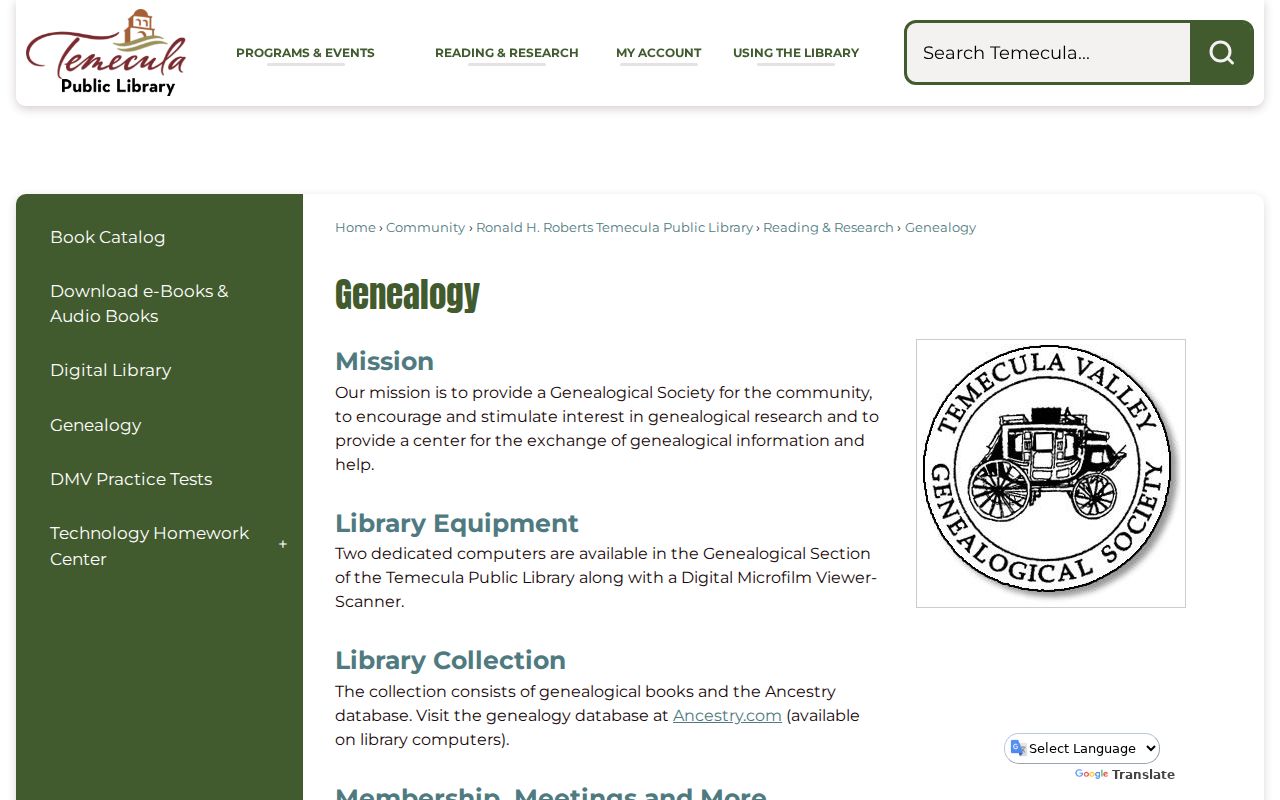
The genealogy image points to the two dedicated computers and scanner, while the branch reference desk can confirm which local directory years are actually available.
Ronald H. Roberts Temecula Public Library is at 30600 Pauba Road, Temecula, California 92592, phone 951-693-8900. Stated hours are Monday through Thursday 10-8, Friday 10-6, Saturday 10-5 and Sunday 1-5. Ask staff to search the county catalog for these volumes, telephone books, high-school yearbooks, newspapers, genealogy databases and vertical files. The branch page did not publish an exact directory-year list, so a reference answer is part of the research.
The Temecula Public Library branch information helps confirm access details before a visit.
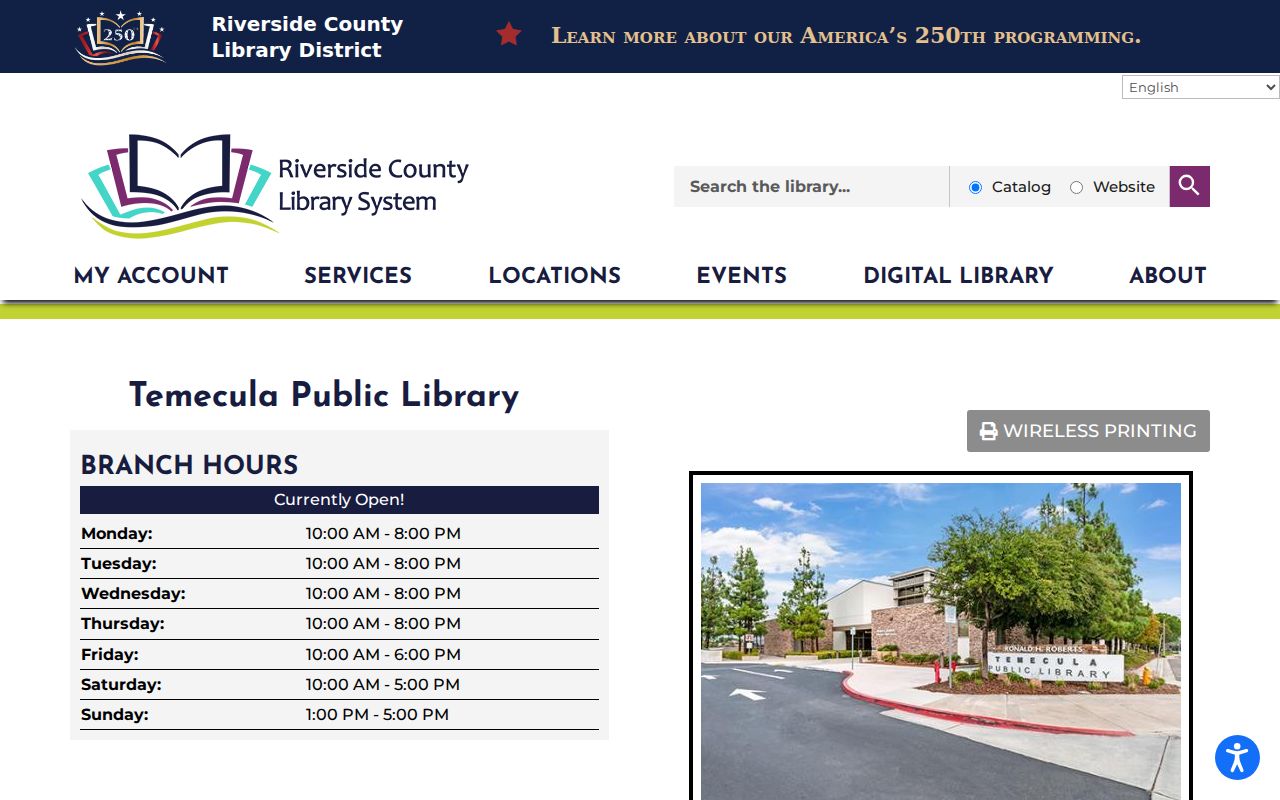
Library access is more than a shelf search. The scanner can preserve a page for comparison, and the in-library database license can expose related genealogy material that is not an open home search.
The county library history places the Temecula branch in a longer local timeline: the branch began in 1972, the Grace Mellman Community Library opened at its County Center site in 1992, and the present city library opened in 2006. Those moves are useful clues when an older local file may have been transferred between branches.
Note: An exact shelf check is the honest answer when a Temecula directory year is not listed online.
Temecula City Clerk Files Are a Different Shelf
City-created records can corroborate a person's public role or a place without becoming a resident list. Temecula City Hall, at 41000 Main Street, Temecula, California 92590, is the custodian route for council records, ordinances, resolutions, contracts, correspondence, claims and other city-created material. The City Clerk can route a California Public Records Act request, but the request should name an existing record, date span, department, address or parcel, permit number, sender or recipient, or subject.
The searchable municipal staff directory exposes Category, First Name and Last Name fields plus department telephone numbers. It is a directory of public officials and work contacts, not private residents. Council agendas, minutes, video and campaign or economic-interest filings may document civic participation, but an agenda appearance is not proof of residence. The CPRA determination is ordinarily due within ten days, with up to fourteen more days for unusual circumstances; that deadline is not necessarily final production.
The Temecula City Clerk records page shows the municipal route that should be kept separate from the historical shelf.
City Clerk records can place a name in a public civic record, but the office does not publish a verified citywide private-resident register.
The Temecula municipal staff directory is useful for identifying the right department or public contact. It should not be used to infer a home address.
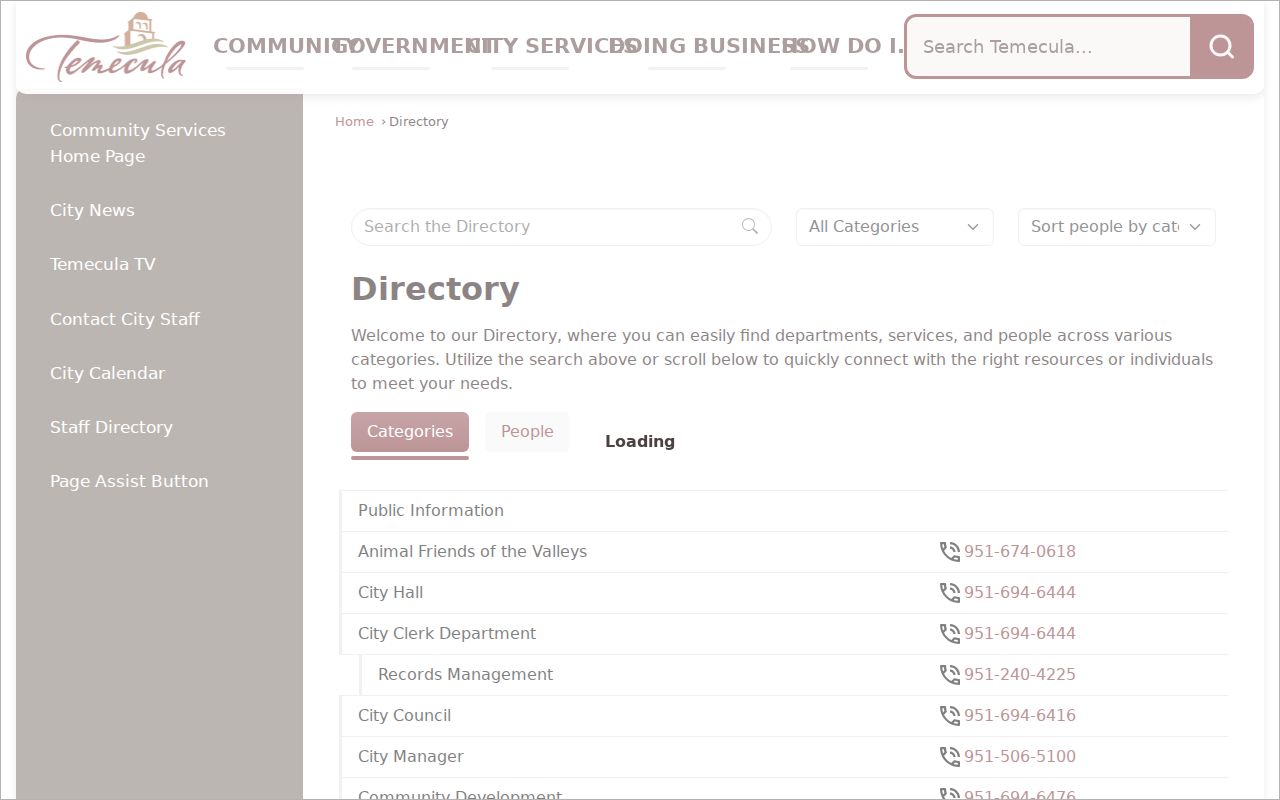
The staff search is a public-office lookup, not one of the historical collections listed in the coverage table.
Riverside County's American Rescue Plan records-preservation page reports funding for official-record digitization, but it does not identify a series, completion date or expanded Temecula directory portal. Treat the funding notice as administrative context, not as proof that a missing volume is online.
Reading a Temecula City Directory Entry
A city directory entry is only as useful as its printed context. The verified Bynon description establishes a community-by-community resident-name arrangement, but an actual Temecula line from the scanned volume was not machine-inspectable in the research run. No spouse, occupation, street address, owner mark or other field should be claimed as present simply because another publisher sometimes used it.
Preserve the page image, volume title, community heading and printed surname before transcribing. OCR can help find a page, but letters and punctuation must be checked against the image. If a later volume is found at a library or museum, record its publisher, year, arrangement and abbreviation key before treating it as a comparable source.
| Printed name | Record the exact surname and given name visible in the verified page; no uninspected Temecula line is quoted here. |
|---|---|
| Community heading | The Bynon directory is verified as community-arranged; preserve that heading because it may not equal a modern city label. |
| Occupation or business | Not verified in the inspected Temecula entry; record it only if the page actually prints it. |
| Spouse or relationship | Not verified in the inspected entry; do not infer a spouse, widow status or family link. |
| Address or locality | Not verified as a field in the inspected line; do not turn a community heading into a street address. |
| Ownership mark | No local owner or occupancy mark was verified; do not import a symbol from an unverified Polk or reverse run. |
- Criss-cross directory
- A street-order section that may connect an address to a listed name. No Temecula run or year range was verified.
- Householder index
- An index organized around household heads or a named household entry set. Its presence must be confirmed in the volume.
- Abbreviation key
- The publisher's explanation of short forms and symbols. Photograph or transcribe it before reading entries.
Temecula City Directory Museum Requests
The Temecula Valley Museum accepts professional, educational and personal research requests. Send a person, place and era, then ask what photographs, maps, family files, business material or local-history context can be consulted. The exact finding aids and fees are not posted, so the museum should be asked about the item rather than described as holding a particular directory run.
The museum also presents “Out of the Archives” stories monthly and offers Old Town walking tours. The city's 2025 Year in Review reports ten such presentations. Those programs can help place a surname in a changing landscape, especially when a directory uses a community name that no longer appears in a current address. They are historical-context resources, not open resident lists.
The Temecula Valley Museum research gateway is the appropriate source link for a local-history request.
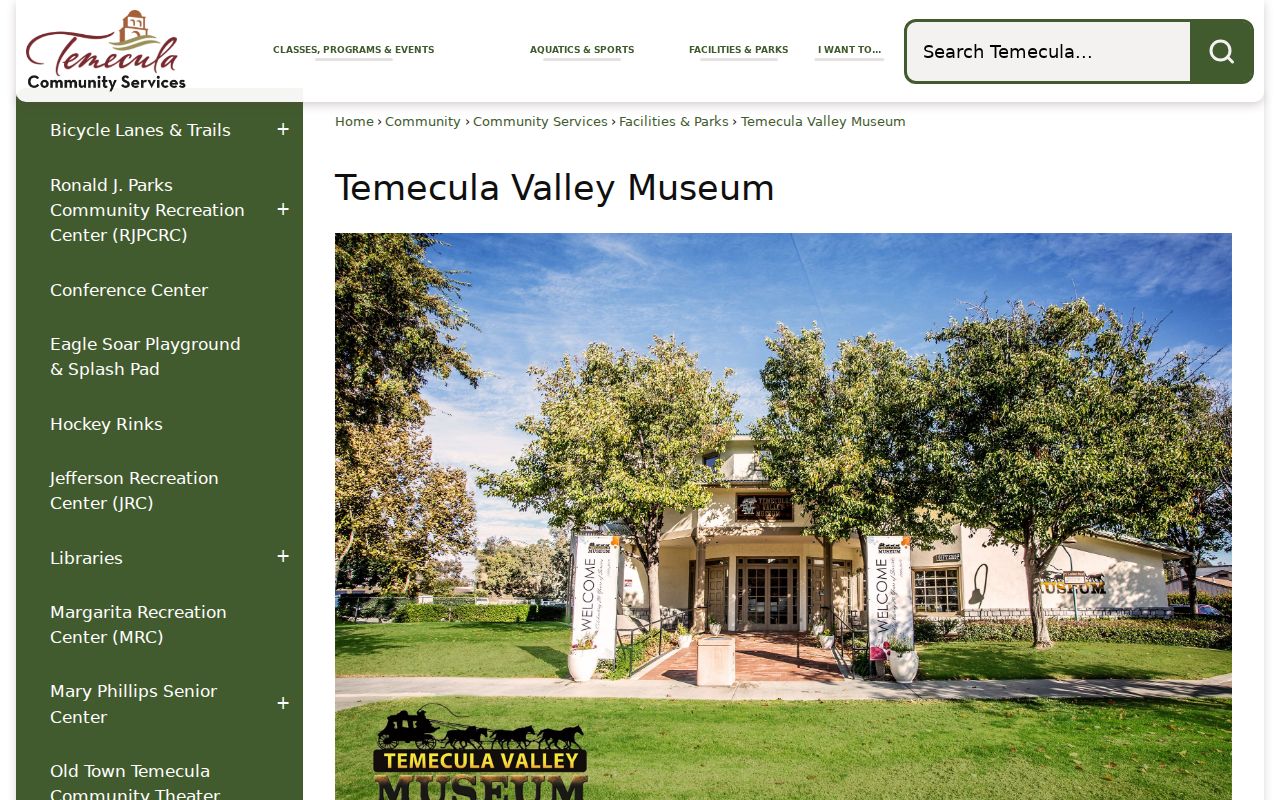
A museum response can add a photograph, map or place clue to a directory name, but each addition still needs its own date and source.
The Temecula Valley Genealogical Society at tvgs.net is another interpretation route. Its collection, surname research and educational resources can help with method and context without supplying a current private-resident list.
Temecula Place Names Across Directory Years
Place names are a core directory problem. Temecula records can point to Pechanga village near Temecula and Murrieta Creek, a later settlement near today's Redhawk bridge, Old Town after the 1882 railroad, or the incorporated city after the November 1989 vote. A reference to Rancho California may describe pre-incorporation geography, while an older event can belong to San Diego County because Riverside County was not organized until 1893.
Use the event date and the community heading together. Do not force a 19th-century entry into today's city boundary or assume that a modern ZIP label was used at the time. The same surname may need a search through the Bynon volume, census geography, county death material, deeds and museum maps before the identity is stable.
Regional Books Around the Temecula City Directory
Three regional biographical works widen the historical shelf without pretending to be reverse directories. Wallace W. Elliott and Company published an 1883 History of San Bernardino County, reprinted in 1965. Lewis Publishing issued an 1890 Illustrated History of Southern California. Elmer Wallace Holmes and the Historic Record Company produced a 1912 History of Riverside County with biographies and a locally produced names index.
These books are name and biography sources. They can supply a place, family connection or public profile for a person who appears in a county directory, but they do not establish a complete street list. Read the biographical statement beside a date and geography, then seek an independent census, deed, death or court record if the question depends on identity.
The National Archives census guidance provides the pairing point for population schedules. The 1950 census is the newest public schedule because of the 72-year rule, and its image should be checked when OCR or place names are uncertain.
Trace a Temecula City Directory Household
A volume becomes stronger when each year is treated as a dated snapshot rather than a continuous resident roll. Start with a printed name and community, then look for the same spelling, a plausible move and a matching census household. A disappearance can mean a move, death, an unlisted person or a gap in the source. It cannot be explained from one missing line alone.
- Find the earliest supported appearance. Note the volume, page, community and exact spelling before changing punctuation or initials.
- Follow forward by year. Record every address or locality only when the page actually prints it, and mark gaps rather than filling them with assumptions.
- Check the volume's arrangement. A community list, a name index and a street-order section answer different questions. Do not call an unverified shelf criss-cross.
- Pair the name with census schedules. Search the 1900, 1910, 1920 and later public schedules by place or enumeration district, then inspect the image for household relationships.
- Close with a dated endpoint. Use the death-record index, obituary, probate case, deed or museum file that fits the person's geography and time.
The county death-record films cover 1893-1919 with some district material to 1920, while census access reaches through 1950. Deeds and probate can explain a transfer, but a directory name by itself does not prove that a person owned or occupied a particular home. For modern address-keyed evidence, the Temecula street directory by address keeps the parcel workflow separate from this historical shelf.
A Temecula Directory Research Timeline
Dates help determine which geography and custodian should be searched. They also show why a single modern volume cannot answer every historical question.
- 1859: The first post office and Butterfield station establish an early place reference.
- 1882: The railroad arrives at Old Town, adding a distinct settlement label.
- 1893: Riverside County is organized, and Board of Supervisors records begin at the Fitch Archives; the Bynon county volume follows in 1893-94.
- 1992: The Riverside County Historical Commission Press centennial reprint provides a local reference copy of the scarce directory.
- 2022: The 1950 census becomes public under the 72-year access rule, giving directory research its newest open population schedule.
There is no verified first or last printed Temecula-specific directory year, no confirmed publisher change sequence and no verified Sanborn sheet for Temecula in the inspected catalog. Those gaps belong in the research log, not in a fabricated timeline.
Where Temecula Directory Claims Stop
The research supports one complete public-domain county directory, companion county and state records, library equipment and museum assistance. The verified Temecula city directory starting point is distinct from any later shelf claim. It does not support a claim that Temecula has a verified Polk run, telephone-book sequence, reverse directory, comprehensive church directory, or exact city-specific year range. A local catalog check may discover one, but discovery is not the same as evidence already verified.
When a shelf answer is needed, ask both Temecula library branches and the museum for the title, publisher, years, arrangement and access conditions. For a name that needs modern corroboration, use the Temecula resident lookup only after preserving the historical source's exact spelling and geography. That handoff prevents an old community entry from being treated as a current identity match.
Note: A careful “not verified” label protects the value of the sources that are verified.