How Temecula Residents Are Found
Temecula is an incorporated city in southwestern Riverside County. Its identity records sit with several custodians. The Riverside County Assessor-County Clerk-Recorder links a street address to a parcel. It also maintains the recorder index. The city clerk holds city-created files. Riverside Superior Court hears Temecula cases because the city runs no separate municipal court. State offices hold the rest. Vital records, licenses, business filings, and voter systems live there. A Temecula residents directory works best when the search starts right. The record should fit the clue.
An address opens one path: an APN, an ownership entry at an ACR office, a deed chain. A name works differently. It can open a court index, a business filing, a license, or an old city directory. Family-history questions may need a library catalog, census image, death index, or museum request. None of these alone proves current residence. A property owner, tax mailing addressee, voter status, court party, or business contact can point to a person. But that still does not show who occupies a home now.
- Start with the clue you can state plainly: a street address, APN, full name, case number, event, or past community name.
- For an address, use the Riverside County Property Search to find the parcel. Save the APN and keep the situs address apart from any mailing address.
- For ownership, use the ACR office inspection route under Revenue and Taxation Code §408. Then search the owner in the Riverside recorder index for deeds, liens, and related filings.
- For a person or family event, compare the court, vital, business, license, voter-status, library, or museum trail that answers that question.
- When an existing record is not online, send a focused request to the custodian through the city or county channel. A California Public Records Act request seeks an identifiable record, not a custom resident list.
Temecula Offices Behind the Resident Records
Three desks anchor the Temecula residents directory. Each answers a different question. The Riverside County Assessor-County Clerk-Recorder combines assessor, clerk, and recorder functions in one office. Its property search finds an APN from an address. Owner names stay off the web result, though. The recorder name index is a separate path for recorded instruments, while California My Voter Status verifies one voter privately rather than listing Temecula voters.
Riverside County ACR
Assessor, County Clerk, and Recorder
Official records and copy orders
ACR: 800-696-9144
Riverside County Property Search
Address, APN, and parcel clues
Owner names are office-only online
Ownership under R&T Code §408
Property Search
California Voter Status
Self-check for registration details
Not an open resident directory
SOS personal lookup
The clerk side of the same office handles marriage licenses, fictitious business names, and other clerk filings. City records belong with Temecula City Clerk and Records Management. Court files belong with Riverside Superior Court. Naming the right office matters. A staff listing, business filing, or recorded deed records an affiliation. It is not a full resident roll.
Temecula's Address-to-Owner Trail
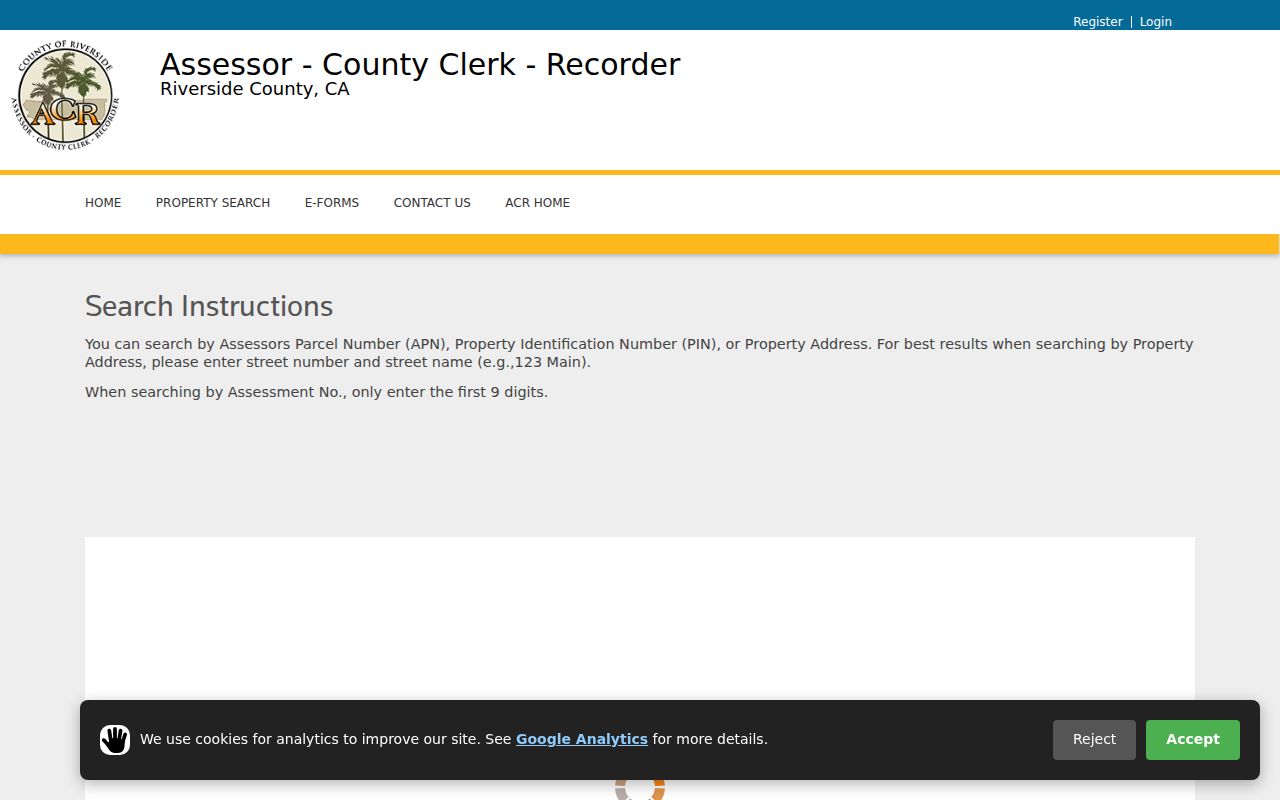
A Temecula address search begins with a small string. Use the street number and street name, leaving off the city and suffix. The search accepts a Property Address, APN, or PIN through the Riverside County Property Search. What comes back is parcel and assessment clues. Owner names are deliberately absent from the web result. The January 1 ownership roll can be inspected at an ACR office. That right comes under Revenue and Taxation Code §408. That is a disclosure boundary, not a broken search.
| Search field | Type | Required | Format or result |
|---|---|---|---|
| Search choice | Radio or tab | Yes | APN, PIN, or Property Address |
| APN | Text | Conditional | Use the parcel number supplied by the record or map |
| PIN | Text | Conditional | First nine digits only; omit the dash or check digit |
| Property Address | Text | Conditional | Street number plus street name, such as 123 Main |
| Search | Button | Yes | Parcel and assessment location; no web owner name |
Save the APN, situs address, assessment clues, and any tract or lot reference. The city GIS then adds zoning, hazards, HOA geography, maintained streets, and nearby parcels. A parcel polygon is context, not a legal boundary survey. The owner name still comes from the office route. The recorder search then starts with that person rather than the street.
The county property search screen shows why the APN is the sturdy bridge between Temecula's street labels and its deeper records.
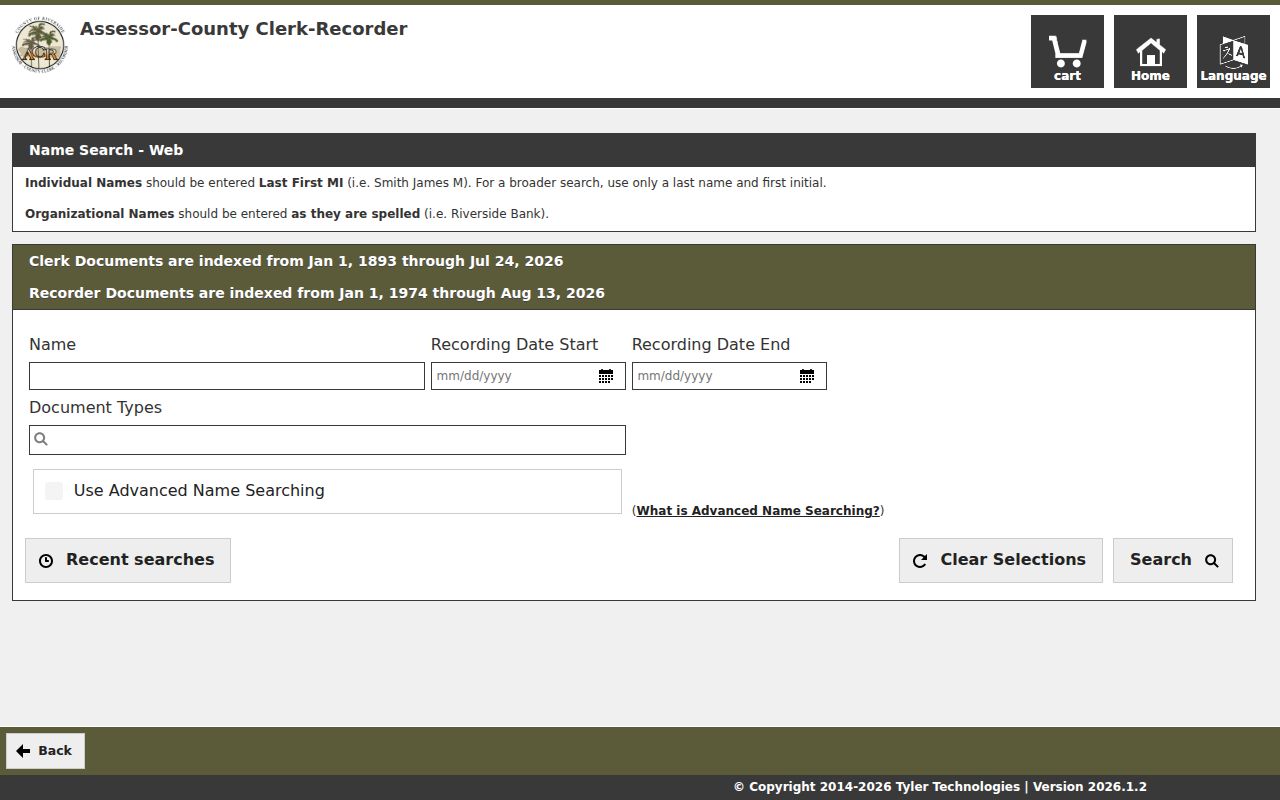
Once the owner is known, type the name into the recorder index as LAST FIRST MI. Skip the punctuation. A recorded deed gives notice of a conveyance. It does not prove current occupancy, so pair the result with the assessment date and other evidence.
Riverside Boundaries in a Temecula Resident Search
Online reach has a date and a keeper. Riverside ACR's web recorder index begins January 1, 1974. The clerk-document index reaches back to January 1, 1893. Office computers search records back to 1975, and the Gateway Riverside location handles 1974 and earlier recorder research. The ordinary online workflow supports copy orders. Office terminals can expose images that the free screen does not. A careful Temecula residents directory labels each cutoff instead of calling 1974 the start of county deeds.
Riverside Superior Court supplies another boundary. Temecula civil cases begin in October 1996 and small claims in September 1996. Family coverage runs almost entirely from April 1992 forward, and probate from July 1994 forward. The public portal requires an account. It uses credits for civil name and criminal or traffic name searches, and it separates the index, register of actions, calendar, documents, and probate notes. A court web result is not the official record.
| Access route | What it is good for | What to expect |
|---|---|---|
| Free online index | Names, dates, document types, case numbers, or parcel clues | Coverage limits and restricted fields apply |
| Office terminal or counter | Ownership inspection, older books, image review, and clerk help | Visit the custodian and follow its access process |
| Paid copy or official search | Certified or paper evidence and a staff-performed search | Fees depend on record type; an index hit is not a certified copy |
Copies carry set fees. The recorder charges $8 for the first page and $1 for each added page. Certification adds $2, and the online card fee runs 2.15 percent. The court keeps its own search and copy schedule. Read the current custodian page before paying, and keep the document or case number with the result.
The Riverside deed-name search makes the person-name boundary visible. The street is only a starting clue. The recorded trail is indexed by people and document data.
Note: The recorder's $8 first-page copy fee and the Gateway fallback make a free index handy for discovery, though it never replaces the record itself. Get the certified copy when it matters.
Current Temecula Resident Directories
Think of current Temecula resident directories as several narrow rolls instead of one book. The property search pins down a parcel. The assessor counter hands you the permitted ownership view. The recorder index then follows a person's recorded instruments over time. Court and vital systems sit behind tighter access rules. They answer case or life-event questions rather than address questions. City tools cover public work, permits, and civic activity. Each row in the Temecula residents directory tells you what a source can show. It also shows what that source cannot claim.
| Source | Who It Lists | Keeper | Access |
|---|---|---|---|
| Property search and assessor roll | Parcels, situs, values; owner at the office | Riverside County ACR | Address/APN web search; office inspection |
| Recorder index | Parties to deeds, liens, maps, and releases | Riverside County ACR | Web from 1974; older books at Gateway |
| My Voter Status | One person's registration status and election details | California Secretary of State | Personal verification, not an open name list |
| Superior Court access | Public case parties, filings, hearings, and docket events | Riverside Superior Court | Account, category dates, credits, and limits |
| Temecula staff directory | Public employees and work contacts | City of Temecula | Free search by category, first name, last name |
| Permits and CPRA files | Applicants, contractors, project scope, and dates | Temecula departments | Online services or focused request; exemptions apply |
Match each source to the question it actually answers. A deed confirms a recorded conveyance. A permit dates the work and names an applicant or contractor. A staff listing confirms a public work contact. A voter status result confirms only the person who ran the check. It does not confirm a casual neighbor search. A current Temecula resident lookup gets stronger when two independent records agree. Look for agreement on a name, date, address clue, or legal description.
The Temecula municipal staff directory helps you find the right city desk. Just remember that a work phone is not a private home address. An appearance on an agenda is not proof of residence either.
Temecula Residents and the Voter Status Door
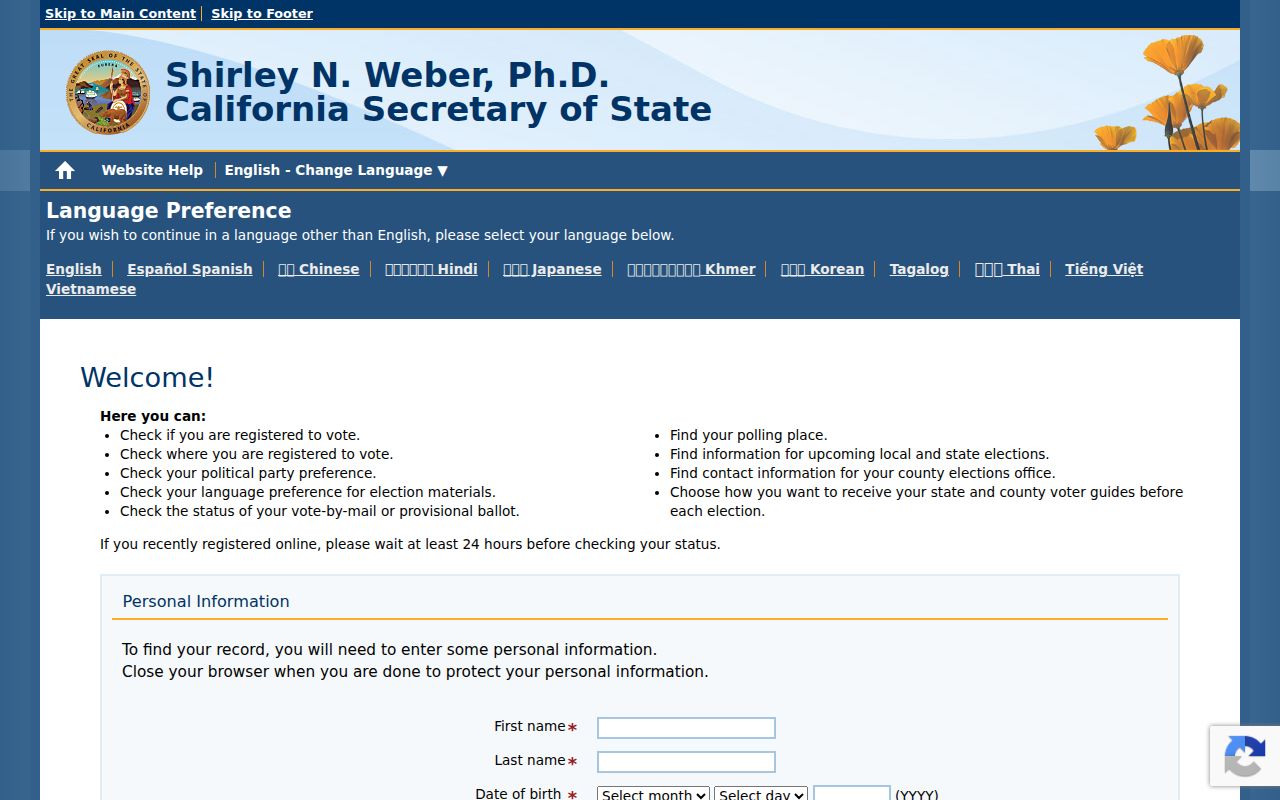
California My Voter Status lets a person confirm registration status, party preference, polling place, vote-by-mail status, and election information. The tool asks for personal identity and residence details. It is a self-service confirmation tool. It is not a public name directory. An ordinary reader cannot browse every voter at a Temecula address through it.
California limits voter-file access to approved election, governmental, scholarly, journalistic, or political purposes. The authority comes from Elections Code §§2188 and 2194 and 2 CCR §§19001-19013. The statewide file costs $100. A specific-voter request costs $30 per record, capped at $100. No more than ten named voters may be included per application. Each request must state the lawful purpose. It must also list the people who will use the file, security controls, and related declarations. Personal or commercial communication, solicitation, and harassment are prohibited uses.
- Roll
- A dated list kept for a public purpose, such as ownership, taxation, or election administration.
- Index
- A finding aid that points to a record or filing; it is not the same as the full image or a certified copy.
- Parcel
- A mapped unit of land tied to an APN, legal description, and situs address.
- Criss-cross directory
- A reverse-style directory organized by street or address. No authoritative Temecula run or year range was verified.
Participation history shows whether and how a ballot was cast, never the voter's choices. Safe at Home participants use a confidential registration route instead of ordinary online registration. Those limits keep voter status useful for personal verification. At the same time, they block a casual street-by-street people list.
The My Voter Status form is a personal check. So its place in a Temecula residents directory is a verification step rather than a browseable roll. Treat it accordingly.
Temecula City Records at the Clerk's Desk
Temecula City Hall, at 41000 Main Street, Temecula, California 92590, is the city route for council records, ordinances, resolutions, contracts, correspondence, claims, and other city-created files. City Clerk and Records Management answers at 951-694-6444, Monday through Friday, 8 a.m. to 5 p.m. The City Clerk records gateway and the city public-records request page point you to the right channel. The City Clerk records gateway is one option. The city public-records request page is another.
A focused California Public Records Act request should name an existing record. It should also name a date span, department, address or parcel, permit number, sender or recipient, or subject. The ordinary determination period is ten days. Unusual circumstances can add up to fourteen more. A custodian may provide electronic records, inspection, copies, a withholding explanation, or a request for clarification. CPRA does not require the city to build a new resident directory.
Permits and code files can connect an address to an applicant, contractor, project, inspection, notice, or resolution date. Building and Safety, Permit Center and Planning, Code Enforcement, Land Development, and Community Development each run separate desks. Each desk is separate. An applicant or contractor is not automatically an occupant, so read the connection carefully. For a postal Temecula address outside the incorporated city, county Building and Safety is the better starting office. The county desk serves postal addresses outside the city.
City files explain civic activity and property work. County rolls and state indexes carry the broader resident trail. That division is why the Temecula residents directory names the custodian before it suggests a search.
Temecula's 1893-94 Resident Directory Story
The county directory of 1893-4 is a small records story with one useful human detail. A. A. Bynon & Son and the Riverside Daily Press Job Office published History and directory of Riverside County, 1893-4 in Riverside. The Library of Congress holds a downloadable PDF, text, and image scan. Its 152 pages of history and 189 pages of directory material arrange resident names community by community. That is a name-and-place source, not proof of a modern Temecula street list.
A Riverside Public Library bibliography notes something rare. Fewer than a handful of original copies were known when the centennial reprint was described. The reprint and scan matter for a simple reason. The book records a new county's early geography in one surviving source. Regional companions include the 1883 history of San Bernardino County. Others are the 1890 illustrated history of Southern California and the 1912 history of Riverside County with biographies and a local names index. These are biographical or historical name sources, not verified reverse directories.
Read a community heading with care. Riverside County did not exist before 1893. A Temecula event may sit under San Diego County or another predecessor frame. A name from the Bynon volume grows stronger with support. Pair it with a census image, deed, death index, probate file, or museum record from the same place and time.
The Library of Congress directory scan is the cleanest free starting point for this early Temecula resident trail.
Temecula's Four Historical Record Geographies
Temecula never sat under one fixed label. The original Pechanga village area sat near Temecula and Murrieta Creek. A later settlement sat upstream, near today's Redhawk bridge. Old Town formed after the railroad arrived in 1882. The modern city dates to the November 1989 incorporation vote, and the first post office and Butterfield station go back to 1859. One family record may carry a community name, a rural route, Rancho California, a township and range, or a plain city label.
Geography also moves the right custodian. Anything before 1893 may route to San Diego County. A 1970s subdivision record can overlap the recorder's 1974 web boundary. Modern tract and lot data can bridge a renamed street, while an APN keeps the land connection intact. ZIP areas reach past the incorporated city. Wine Country, De Luz, Morgan Hill, and other postal Temecula zones all stretch beyond the city line.
The growth curve explains the scatter. Temecula held about 200 residents in 1970. The count reached 1,783 in 1980 and 27,099 in 1990. Census QuickFacts lists 110,003 residents in 2020 and a July 1, 2025 estimate of 114,865. Current resident records spread across master-planned tracts, city files, county property systems, state affiliations, and historical collections.
The Census QuickFacts table supplies the population context. The records themselves still demand the correct place name and date.
Temecula Resident Rolls: Official Versus Purchased Data
Official records and commercial data products answer different questions. A county index, city file, court docket, library scan, or state lookup has a named custodian and a stated access rule. A paid product blends public records with purchased data, old addresses, or merged names. Payment changes nothing. A compiled result never becomes a certified public record.
| Source category | Strength | Limit |
|---|---|---|
| Official county or state roll | Clear custodian, source field, and legal access rule | Coverage dates, privacy limits, and record purpose still apply |
| City or library collection | Local context, public files, directories, maps, or historical clues | May cover only a function, era, or community |
| Commercial compiled category | May surface a lead across several record types | Dates, identity matches, and source paths can be unclear |
Use a compiled result as a lead, nothing more. Family history, reconnecting, checking a seller's public affiliation, or tracing a house all end at the same place. Go back to the ACR index, court clerk, state office, library, or city custodian for the exact record. A business filing can name an agent or operator. A license can show an address of record. Neither makes a home address certain. The California bizfile Online search shows how an official affiliation index works, returning entity identifiers, status, jurisdiction, addresses, agents, and public filing history where available.
Protecting a Temecula Resident Record
California's privacy tools target different exposures. The Delete Act's DROP platform launched January 1, 2026. One verified request can reach 600+ registered data brokers. Broker profiles can hold names, former names, birth date, ZIP, emails, phones, and other identifiers. Starting August 1, 2026, brokers must retrieve and process lists at least every 45 days. Status updates can take up to 90 days.
DROP erases no deed, court docket, or other public government record. For a qualifying survivor, California Safe at Home offers a substitute mailing address, confidential voter registration, mail forwarding, and related protections under Government Code §§6205-6211. Government Code §6208.1 also limits online publication of a participant's address, phone, or image after the required demand. A wrong record belongs with its custodian. No directory site can rewrite it.
Lawful personal use. Temecula records are for family history, civic research, reconnecting, property curiosity, and other lawful purposes. Do not use a resident record to stalk, harass, intimidate, or harm a person. If a record looks wrong, contact the office that created or keeps it.
Send scam reports to the right office. Riverside ACR's real-estate fraud program mails courtesy notices for qualifying recordings. An unfamiliar deed can be checked with ACR. It can also be checked with the Riverside District Attorney's Real Estate Fraud Unit at 877-723-7779. The DROP platform is explained at privacy.ca.gov/drop. Safe at Home details come from the Secretary of State.
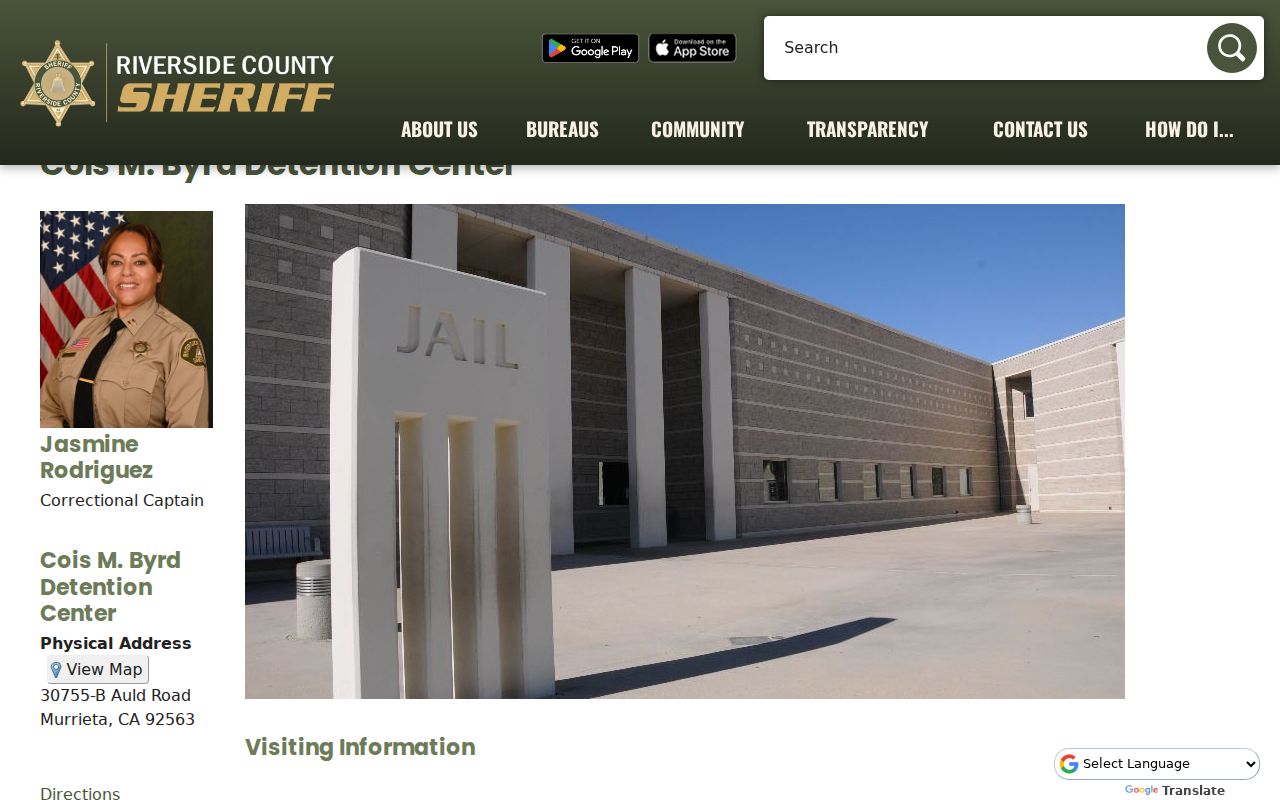
Not every official identity trail is a residents directory. The Riverside County Sheriff inmate locator supplies current custody information only. Confirm custody with the jail, and keep the tool apart from a general residents directory.
Note: A state privacy tool can shrink broker exposure, but it cannot change the custodian, date, or purpose of a public record. The record itself stays where the law puts it.
Historical Temecula Resident Directories
Temecula's earliest directory trail is regional, not a modern city book. The Library of Congress hosts a free scan of History and directory of Riverside County, 1893-4. It lists resident names by community. A Riverside Public Library bibliography also notes a 1992 centennial reprint. The volume appeared the year Riverside County formed. Because of that, older Temecula clues may hide under San Diego County or an earlier geography.
Treat any directory name as a lead. Test it against a census image, a deed, a probate file, a newspaper, or a museum holding. Exact Temecula Polk, telephone, reverse, or crisscross runs cannot be confirmed. So no local shelf claim is made for them. The Temecula city directory collections page gathers the historical-shelf detail, including library and museum routes.
The Grace Mellman Heritage Room and the Temecula Valley Museum round out the picture. They add photographs, maps, and family or business files. One past residents source may list a household that another misses entirely. Place names, community boundaries, and record purposes all shifted over time.
The Riverside County library history page records the local branch chronology. It also covers the Heritage Room setting. Knowing that history helps a researcher ask for the right shelf. It also guards against assuming every old Temecula residents directory is already digitized.